All about BIOINFORMATICS:
In this page we will see all about Bioinformatics information.
Bioinformatics- Introduction and Applications:
- With a large number of prokaryotic and eukaryotic genomes completely sequenced and more forthcoming, access to the genomic information and synthesizing it for the discovery of new knowledge have become central themes of modern biological research.
- Mining the genomic information requires the use of sophisticated computational tools.
- It therefore becomes imperative for the new generation of biologists to initiate and familiarize with a field of study that is concerned with the careful storage, organization and indexing of information in order to tackle the new challenges in the genomic era.
- Information science has been applied to biology to produce a field is called bioinformatics.
- It is concerned with the state of- the-art computational tools available to solve biological research problems.
- The term bioinformatics was coined by Paulien Hogeweg and Ben Hesper to describe “the study of informatic processes in biotic systems” and it found early use when the first biological sequence data began to be shared.
- Bioinformatics is an interdisciplinary field that develops methods and software tools for understanding biological data.
- The development of bioinformatics as a field is the result of advances in both molecular biology and computer science over the past 30–40 years.
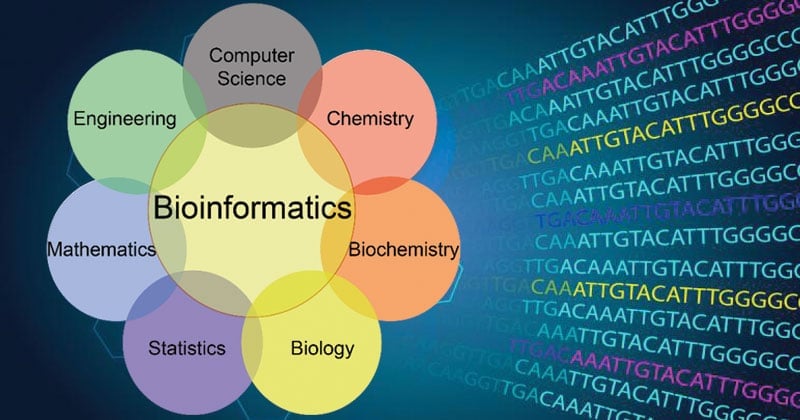
- As an interdisciplinary field of science, bioinformatics combines biology, computer science, information engineering, mathematics and statistics to analyze and interpret biological data.
- The key areas of bioinformatics include biological databases, sequence alignment, gene and promoter prediction, molecular phylogenetics, structural bioinformatics, genomics, and proteomics.
Bioinformatics vs Computational Biology :
Bioinformatics differs from a related field known as computational biology.
- Bioinformatics is limited to sequence, structural, and functional analysis of genes and genomes and their corresponding products and is often considered computational molecular biology.
- However, computational biology encompasses all biological areas that involve computation.
- Bioinformatics as the development and application of computational tools in managing all kinds of biological data, whereas computational biology is more confined to the theoretical development of algorithms used for bioinformatics.
Applications of Bioinformatics:
Bioinformatics has not only become essential for basic genomic and molecular biology research, but is having a major impact on many areas of biotechnology and biomedical sciences. The main uses of bioinformatics include:
- Bioinformatics plays a vital role in the areas of structural genomics, functional genomics, and nutritional genomics.
- It covers emerging scientific research and the exploration of proteomes from the overall level of intracellular protein composition (protein profiles), protein structure, protein-protein interaction, and unique activity patterns (e.g. post-translational modifications).
- Bioinformatics is used for transcriptome analysis where mRNA expression levels can be determined.
- Bioinformatics is used to identify and structurally modify a natural product, to design a compound with the desired properties and to assess its therapeutic effects, theoretically.
- Cheminformatics analysis includes analyses such as similarity searching, clustering, QSAR modeling, virtual screening, etc.
- Bioinformatics is playing an increasingly important role in almost all aspects of drug discovery and drug development.
- Bioinformatics tools are very effective in prediction, analysis and interpretation of clinical and preclinical findings.

So this is in today's web page .
Stay tuned for further hot updates.

Comments
Post a Comment